
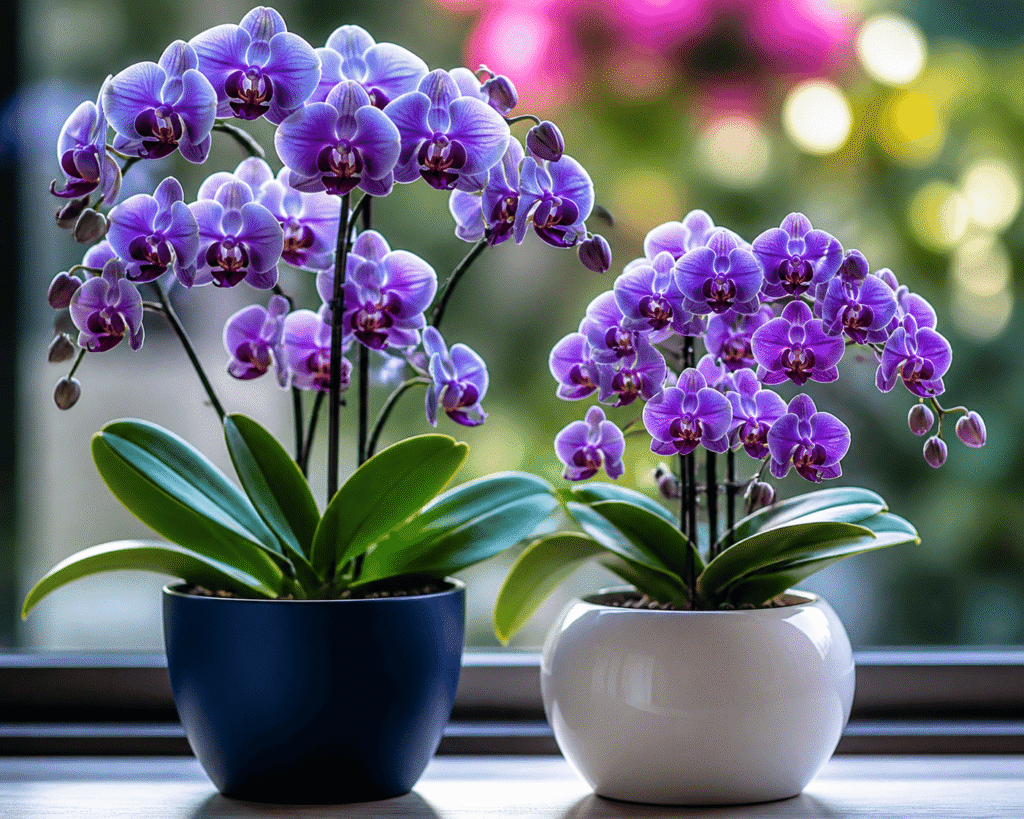
Phalaenopsis orchids are often called difficult plants, but many orchid problems begin with advice that sounds reasonable.
“Water it every Sunday.”
“Give it a few ice cubes.”
“Cut off those roots growing outside the pot.”
“Add bloom booster if it will not flower.”
These instructions are easy to remember, which helps explain why they spread. Unfortunately, a simple rule may ignore the plant’s roots, potting material, light and home environment.
A practice that appears successful for one grower may be harmful in another home.
The safest way to care for a moth orchid is not to follow a collection of rigid tricks. It is to understand what the plant needs and observe how it responds.
Here are seven common orchid-care myths that can damage a Phalaenopsis—and what to do instead.
Quick Summary: Seven Myths to Stop Believing
| Myth | Why it can cause trouble | Better approach |
| Water every seven days | Drying time varies greatly | Check roots and medium first |
| Use ice cubes | Cold, limited water may hydrate unevenly | Use room-temperature water and drain |
| Plant orchids in ordinary soil | Dense soil restricts air around roots | Use an airy orchid medium |
| Mist the leaves every day | It does not water roots and may leave the crown wet | Water the root zone properly |
| Cut off aerial or yellow roots | Many unusual-looking roots are healthy | Test roots for firmness |
| Move an orchid into a large pot | Extra medium may remain wet too long | Match the pot to the roots |
| Use more fertilizer to force flowers | Excess salts can damage roots | Feed modestly and correct light first |
The myths have one thing in common: they replace observation with an automatic action.
Myth 1: “Water Your Orchid Once a Week”
A weekly schedule sounds convenient, but your orchid does not know what day it is.
A Phalaenopsis may dry in four days under warm, bright conditions. The same plant may remain wet for two weeks in a cooler, dimmer room.
Drying time depends on:
- Pot size
- Root health
- Bark or moss
- Light intensity
- Temperature
- Humidity
- Air movement
- Season
- Plant growth
Watering every seven days may be suitable at one time of year and too frequent at another.
How the myth causes damage
If you water before the medium has dried sufficiently, the spaces around the roots remain filled with water for too long. Oxygen becomes limited, roots weaken and decay may follow.
As roots die, the leaves can become wrinkled because the damaged system cannot supply enough water.
The grower sees the wrinkled leaves and waters even more frequently, making the underlying problem worse.
What to do instead
Set a weekly reminder to check your orchid rather than automatically water it.
Look for several clues:
- Are the roots green or silver?
- Does the pot feel heavy or light?
- Is condensation still present?
- Is the center of the medium moist?
- Is water trapped in the decorative pot?
Water when the root zone is approaching dryness. Wet it thoroughly and allow it to drain completely.
A better rule
Do not water by the calendar. Water according to the roots and medium.
Myth 2: “A Few Ice Cubes Are the Safest Way to Water”
Ice-cube watering is attractive because it appears simple and measured. Place a few cubes on the medium and let them melt slowly.
However, Phalaenopsis orchids are tropical plants. Ice is not required for their care.
How the myth can cause trouble
A small number of ice cubes may:
- Deliver cold water to a limited area
- Wet only part of the root zone
- Provide too little water for the whole pot
- Fail to flush accumulated fertilizer salts
- Encourage growers to ignore the actual moisture level
A measured amount is not automatically the correct amount.
The root system needs to be hydrated evenly. Excess water must then leave the pot so air can return.
What to do instead
Use room-temperature water.
Remove the inner pot from its decorative container, wet the medium thoroughly and let the pot drain completely.
Check the crown and leaf joints for trapped water before returning the orchid to its growing position.
A better rule
Water thoroughly with room-temperature water, then drain completely.
Myth 3: “Orchids Can Grow in Ordinary Potting Soil”
A Phalaenopsis may look like an ordinary flowering houseplant, but its roots are adapted to a different environment.
Many Phalaenopsis orchids grow attached to trees in nature. Their roots receive both water and air.
Ordinary potting soil is designed for plants with soil-growing roots. It may be too dense and water-retentive for a moth orchid.
How the myth causes damage
Dense soil can:
- Fill the air spaces around orchid roots
- Remain wet for a long time
- Drain slowly
- Hide root decline
- Make moisture difficult to judge
- Encourage the roots to suffocate and decay
Even a pot with drainage holes may remain too wet if its contents are dense.
What to do instead
Use a medium intended for orchids, such as:
- Orchid bark
- Loosely arranged sphagnum moss
- A bark-and-moss mixture
- Bark mixed with perlite or horticultural charcoal
- Another open, well-drained orchid medium
The best choice depends on your growing conditions.
Bark generally dries faster and offers larger air spaces. Sphagnum moss holds more water and must be managed carefully.
A better rule
Phalaenopsis roots need an airy orchid medium—not ordinary garden or houseplant soil.
Myth 4: “Mist the Leaves Every Day to Create Humidity”
Misting seems like a natural way to imitate a tropical environment. Unfortunately, a few sprays do not provide lasting room humidity, and misting the leaves does not properly hydrate the root system.
How the myth can cause trouble
Daily misting may:
- Leave water trapped in the crown
- Keep leaf joints wet
- Encourage spotting under cool, still conditions
- Spread pests or disease between nearby plants
- Create the impression that the orchid has been watered
- Leave the actual roots dry
The crown is the center where new leaves emerge. Water that remains there can damage the growing point.
What to do instead
Water the roots when the medium approaches dryness.
If your home is extremely dry, consider:
- Grouping plants with suitable spacing
- Using a room humidifier
- Keeping orchids away from heating vents
- Providing gentle air movement
Do not keep the pot standing in water in an attempt to increase humidity.
If water enters the crown during watering, tilt the plant or absorb the moisture carefully with a clean paper towel.
A better rule
Healthy humidity does not require keeping the leaves and crown wet.
Myth 5: “Cut Off Roots That Grow Outside the Pot—or Look Yellow”
Phalaenopsis orchids commonly produce roots that extend into the air. These are called aerial roots.
They are not evidence that the plant is untidy, unhealthy or desperate for a larger pot.
Roots inside the pot can also have several normal colors.
Healthy roots may be:
- Green when wet
- Silver-gray when dry
- Cream or white
- Yellow when grown without light
- Light brown from staining
- Bright green or reddish at the tip
Color alone does not tell you whether a root is alive.
How the myth causes damage
Cutting healthy roots reduces the plant’s ability to:
- Absorb water
- Take up nutrients
- Store resources
- Support leaves
- Recover from stress
- Produce future flowers
A plant with a limited root system needs every functioning root it can keep.
How to identify a dead root
A dead root may be:
- Hollow
- Flat
- Mushy
- Brittle
- Completely dry
- Covered by an outer layer that slips away
A healthy root is usually firm, even if its color is not attractive.
What to do instead
Leave firm aerial roots attached.
During necessary repotting, feel each root. Remove only those that are clearly dead, using a clean cutting tool.
Do not force stiff aerial roots into a pot if they may crack or break.
A better rule
Judge roots by firmness and condition—not by location or color alone.
Myth 6: “A Bigger Pot Will Help the Orchid Grow Bigger”
Moving a plant into a larger container may sound helpful. More room should produce more growth—or so the reasoning goes.
For a Phalaenopsis, an oversized pot can create a moisture problem.
How the myth causes damage
A large pot contains more growing material. That material may remain wet long after a small root system has used the available water.
The center may stay moist while the surface appears dry. The grower waters again, and the hidden wet area remains saturated.
This increases the risk of root decline.
When does an orchid need a larger pot?
Consider moving up slightly when:
- The healthy root system genuinely cannot fit.
- The plant is unstable.
- The current pot is damaged.
- Drainage is inadequate.
- The orchid has produced considerable new root growth.
Roots growing outside the pot are not, by themselves, proof that a larger container is needed.
What to do instead
During repotting:
- Remove the old medium.
- Inspect the roots.
- Trim only roots that are clearly dead.
- Choose a pot that comfortably fits the remaining healthy roots.
- Keep the crown above the medium.
- Ensure that water can drain freely.
A small-rooted rescue orchid may need a smaller pot than it previously occupied.
A better rule
Choose the pot for the root system—not for the size of the leaves or flowers.
Myth 7: “More Fertilizer—or Bloom Booster—Will Force Flowers”
Fertilizer provides mineral nutrients, but it is not a magic flowering switch.
A Phalaenopsis needs healthy roots, enough light, suitable temperatures and sufficient maturity before it can flower well.
If one of those foundations is missing, adding more fertilizer will not solve the problem.
How the myth causes damage
Heavy fertilizer use can cause salts to accumulate around the roots.
Possible signs include:
- White deposits on the pot or medium
- Damaged root tips
- Weak or declining roots
- Leaf-tip injury
- A plant that remains dehydrated despite wet medium
A damaged root system cannot support healthy flowering.
Why “bloom booster” can be misleading
Products marketed for flowering often contain a different nutrient balance. But a high number on the label does not guarantee more flowers.
A Phalaenopsis growing in insufficient light may produce leaves but no flower spike, regardless of how much bloom fertilizer it receives.
Likewise, a plant with rotting roots needs root correction—not extra nutrients.
What to do instead
Use an appropriate orchid or balanced fertilizer at a modest concentration, following the product directions.
Fertilize mainly when the plant is actively producing roots and leaves. Periodically water with plain water to help flush accumulated salts.
If the orchid will not bloom, investigate:
- Light
- Root health
- Plant maturity
- Temperature pattern
- Recent growth
- Overall care
A better rule
Fertilizer supports healthy growth; it cannot replace light, roots or suitable conditions.
Why Orchid Myths Continue to Spread
Most myths contain a small piece of truth.
- A weekly watering interval may work in some homes.
- A few ice cubes may keep some orchids alive.
- Moss can resemble ordinary plant material.
- Aerial roots may look unfamiliar.
- Larger pots do give some plants more room.
- Fertilizer is necessary for long-term growth.
The problem begins when a situational practice becomes a universal rule.
Two growers can use different methods successfully because their conditions differ.
One may grow in warm, bright, dry air and use sphagnum moss. Another may grow in a cool, humid room and prefer coarse bark.
Good orchid care is based on matching the method to the environment.
Myth Versus Better Practice
| Instead of doing this | Do this |
| Water every Sunday | Check roots, medium and pot weight every Sunday |
| Add ice cubes | Water thoroughly with room-temperature water |
| Use ordinary potting soil | Use an open orchid medium |
| Mist the leaves daily | Water roots properly and manage room humidity |
| Cut every unusual root | Preserve every firm root |
| Choose a large pot | Fit the pot to the healthy roots |
| Add more fertilizer for flowers | Correct light and root health first |
A Five-Minute Reality Check
Before acting on any orchid-care advice, ask:
1. Does it account for the root system?
If the advice focuses only on leaves or flowers, it may miss the most important part of the plant.
2. Does it account for the potting medium?
Bark and moss retain water differently. The same watering instruction cannot suit both equally.
3. Does it account for the environment?
Light, temperature, humidity and airflow affect how quickly the pot dries.
4. Does it promise an instant result?
Healthy roots and flower spikes develop over time. Be cautious of methods promising guaranteed overnight recovery or immediate flowering.
5. Can the result be observed?
Useful advice should produce signs you can check, such as firm roots, active root tips, stable leaves or appropriate drying.
What to Observe Instead of Following Myths
Your orchid provides useful information through:
Roots
- Firmness
- Color changes after watering
- Active growing tips
- Dead or hollow areas
Leaves
- Firmness
- Yellowing pattern
- Wrinkling
- Spots or damage
- New-leaf size
Potting medium
- Drying rate
- Decomposition
- Smell
- Compaction
- Drainage
Crown
- Firmness
- New growth
- Trapped water
- Dark or soft tissue
Flowering
- Spike development
- Bud formation
- Bud drop
- Duration of blooms
- Time between flowering cycles
Keep simple records. A few dated photographs can reveal gradual changes that are difficult to notice from day to day.
Three Other Misunderstandings Worth Knowing
Although they are not part of the seven main myths, these misunderstandings commonly worry beginners.
“The orchid is dead when the flowers fall”
Flowers are temporary. A healthy plant continues growing roots and leaves after blooming.
“One yellow bottom leaf means the plant is dying”
One lowest leaf that yellows gradually may be undergoing normal aging. Several rapidly yellowing leaves require closer inspection.
“Wrinkled leaves always mean more water”
Wrinkling means insufficient water is reaching the leaves. Damaged roots may be the reason, even when the pot is wet.
Frequently Asked Questions
Is weekly watering always wrong?
No. It may sometimes match the orchid’s drying rate. The mistake is watering weekly without checking whether the plant is ready.
Will ice cubes definitely kill my orchid?
Not necessarily, but room-temperature water applied thoroughly provides a more even and controllable watering method.
Can I use ordinary potting mix if I add drainage holes?
Drainage holes do not make dense soil sufficiently airy. Use a suitable orchid medium.
Are all aerial roots healthy?
Not automatically. Test their condition. Firm aerial roots should remain; hollow or completely dead roots may be removed during repotting.
Should I mist the aerial roots?
Occasional wetting is not the same as proper root-zone watering. Avoid leaving the crown and leaves wet.
Do orchids like small pots?
They generally benefit from pots that fit the root system closely, but the container must still provide drainage and enough room for appropriate medium.
Is orchid fertilizer necessary?
Orchids require mineral nutrients, but only modest amounts. Follow product directions and avoid heavy applications.
Will a high-phosphorus fertilizer make my orchid bloom?
Not by itself. Flowering also depends on light, root health, maturity, temperature and overall growing conditions.
Should I repot immediately after buying an orchid?
Inspect first. Repot promptly if serious root trouble, failed medium or poor drainage threatens the plant. Otherwise, waiting until after flowering may be reasonable.
How do I know which advice to trust?
Look for advice that explains why a method works, acknowledges different growing conditions and encourages inspection before treatment.
Replace Rules With Understanding
Growing a Phalaenopsis successfully does not require a long list of tricks.
It requires a few sound principles:
- Roots need water and air.
- The pot must drain.
- The medium must suit your conditions.
- Watering frequency must change as conditions change.
- Healthy roots should be preserved.
- Fertilizer should be used modestly.
- Adequate light is necessary for flowering.
- Symptoms should be investigated before treatment.
Simple myths are attractive because they remove uncertainty. But plants are living systems, and their needs change.
Instead of asking, “What day should I water?” ask, “Is the root zone approaching dryness?”
Instead of asking, “Which fertilizer forces flowers?” ask, “Does this orchid have healthy roots and enough light?”
Instead of asking, “Should I cut this ugly root?” ask, “Is it firm and functioning?”
Those better questions lead to better orchid care.
Join the Orchid Bloom Lab email list to receive practical, science-based orchid care guidance and downloadable diagnostic resources. You will learn what to inspect, what the signs may mean and what to do next—without relying on guesswork.
Join the email list at https://orchidbloomlab.com
You can also subscribe to the Orchid Bloom Lab YouTube channel for clear visual guidance on watering, root health, repotting, lighting, flowering and rescuing troubled orchids.
Subscribe at https://www.youtube.com/@OrchidBloomLab
Orchid Bloom Lab™
Science-Based Orchid Flowering Tips—Grow Better. Bloom More.