
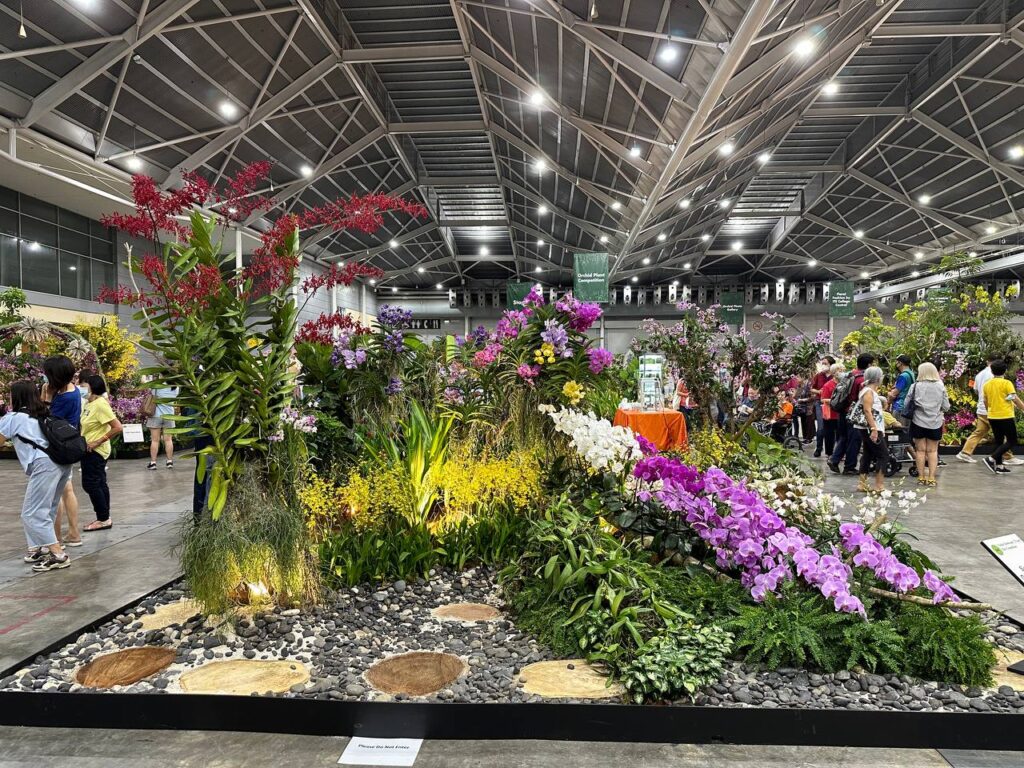
Singapore may be a small island, but in the orchid world, it has an influence far greater than its size.
Here, an orchid is more than a beautiful flower. It can be a national symbol, a scientific achievement, a diplomatic gift, a tourism attraction—or the result of seven years of patient breeding.
From the National Orchid Garden and Gardens by the Bay to international orchid conferences and the unusual practice of naming new hybrids after world leaders, Singapore has made orchids part of its national story.
But what can an everyday orchid hobbyist learn from Singapore’s success?
Quite a lot.
The quick answer
Singapore is famous for orchids because it brings together:
- One of the world’s finest permanent orchid collections
- A long history of orchid breeding and research
- An orchid as its national flower
- Internationally recognised orchid shows and conferences
- Conservation programmes for native species
- The distinctive tradition of orchid diplomacy
- Practical experience growing orchids in a hot, humid climate
Singapore’s orchid story shows that reliable flowering does not happen by chance. It comes from selecting suitable plants, understanding their growing conditions and observing them patiently over time.
1. An orchid became Singapore’s national flower
Singapore’s national flower is Papilionanthe Miss Joaquim, better known to many growers by its former botanical name, Vanda Miss Joaquim.
This sun-loving hybrid produces attractive purple-pink flowers and is capable of blooming repeatedly under warm tropical conditions. It was selected as Singapore’s national flower in 1981 because of its colour, vigour, resilience and ability to flower throughout the year.
Those qualities were also considered representative of Singapore itself: a diverse and relatively young nation determined to flourish despite its limited land and natural resources.
For hobbyists, the story offers a useful reminder:
The best orchid is not necessarily the rarest or most expensive one. It is the orchid whose natural requirements match the conditions you can provide.
A beautiful orchid placed in the wrong light or temperature range may struggle for years. A well-matched plant can grow vigorously and reward you with dependable flowers.
2. The Singapore Botanic Gardens helped build an orchid culture
Founded in 1859, the Singapore Botanic Gardens developed into an important centre for tropical botany, horticultural research and plant conservation.
Its orchid work included:
- Collecting and documenting orchid species
- Breeding new tropical hybrids
- Studying flowering and growth
- Germinating orchid seeds under laboratory conditions
- Developing propagation methods
- Conserving threatened native orchids
- Introducing the public to orchid diversity
This work helped establish Singapore’s reputation for tropical orchid science and breeding.
In 2015, the Singapore Botanic Gardens became Singapore’s first UNESCO World Heritage Site. Although the World Heritage recognition covers far more than orchids, orchids remain one of the Gardens’ most visible and popular attractions.
For the home grower, this scientific heritage contains an important lesson: successful orchid growing begins with observation.
Before changing fertiliser, repotting a plant or attempting to trigger flowering, ask:
- Is the plant receiving enough usable light?
- Are the roots healthy and aerated?
- Does the potting medium dry at an appropriate rate?
- Is the orchid producing new leaves or roots?
- Is the plant mature enough to flower?
- Does this type require a temperature change or seasonal signal?
These questions are usually more useful than simply asking, “Which fertiliser will make my orchid bloom?”
3. The National Orchid Garden is a living orchid library
Within the Singapore Botanic Gardens is the National Orchid Garden, home to more than 1,000 orchid species and 2,000 hybrids.
It is not merely a collection of colourful flowers. It is a living demonstration of how different orchids respond to different environments.
Visitors can see warm-growing tropical orchids outdoors and cooler-growing orchids in carefully controlled environments such as the Sembcorp Cool House and Tropical Montane Orchidetum.
This reveals one of the most important principles in orchid growing:
“Orchid care” is not one universal set of instructions.
A sun-loving vandaceous orchid does not require the same light as a Phalaenopsis. A cool-growing mountain species may not tolerate the temperatures enjoyed by a warm-growing Dendrobium. Some orchids need a distinct rest period, while others grow almost continuously.
Before following any care advice, identify the orchid—or at least its general group. Good advice for the wrong orchid can still produce a poor result.
4. Gardens by the Bay turns orchids into an experience
At Gardens by the Bay, orchids are displayed as part of large, immersive horticultural exhibitions.
The Cloud Forest and Orchid Haven allow visitors to see orchids growing among rocks, mosses, trees and other plants rather than lined up only as individual pots. Seasonal events such as Orchid Extravaganza may feature thousands of orchids combined with the architecture, crafts and cultural traditions of Asian countries.
These displays help visitors understand orchids as living plants connected to particular habitats.
That perspective is useful at home. Instead of treating an orchid as a decorative object, consider how it grows in nature.
Many commonly cultivated orchids are epiphytes. They use trees for support, but they are not parasites. Their roots require air as well as moisture. This explains why tightly packed, permanently wet potting material can be so damaging.
The natural-habitat approach encourages better questions:
- Would these roots normally receive moving air?
- Would they remain wet for several days?
- Would the leaves be exposed to full midday sun?
- Would rainwater drain away quickly?
- Would the plant experience cooler nights or a drier season?
You do not need to reproduce a rainforest in your home. You only need to understand which environmental signals matter most to your orchid.
5. Singapore uses orchids in international diplomacy
One of Singapore’s most distinctive traditions is orchid diplomacy.
New orchid hybrids are selected and named after visiting heads of state, heads of government, members of royal families and other distinguished guests. The tradition began in 1956 with Aranthera Anne Black.
By 2024, Singapore had named more than 280 orchid hybrids after prominent international visitors and organisations.
These are not ordinary plants given ceremonial labels at the last minute. Producing a suitable hybrid may involve years of pollination, seed germination, seedling selection, cultivation and evaluation. Singapore’s Ministry of Foreign Affairs has explained that an orchid prepared for such a ceremony can represent around seven years of work.
The eventual flower therefore represents patience, cooperation and the joining of two different parent plants to create something new.
For hobbyists, this is a reassuring reminder that orchids work on biological schedules—not human deadlines.
A healthy orchid may spend months developing roots and leaves before it is ready to flower. That vegetative growth is not wasted time. It is the foundation supporting the next inflorescence.
6. Singapore has produced internationally recognised hybrids
Singapore has a distinguished history of breeding tropical orchids, particularly heat-tolerant vandaceous hybrids.
One famous example is Papilionanda Tan Chay Yan, bred by Tan Hoon Siang and named after his father. A selected plant was sent from Singapore to the Chelsea Flower Show in 1954, where it received major recognition. It later won further honours at the Second World Orchid Conference in Hawaii.
Achievements like this helped place Singapore firmly on the world orchid map.
Breeders sought more than attractive colours. Commercially valuable orchids also needed qualities such as:
- Vigorous growth
- Reliable flowering
- Strong flower stems
- Long-lasting blooms
- Heat tolerance
- Good flower arrangement
- Suitability for transport
Home growers can use similar thinking when choosing plants. Instead of purchasing an orchid only because its flowers look attractive, consider whether the plant is vigorous, appropriate for your climate and suited to your available growing space.
7. Singapore hosts major orchid shows and conferences
Singapore has hosted several important international orchid gatherings, including:
- The 4th World Orchid Conference in 1963
- The 20th World Orchid Conference in 2011
- The 14th Asia Pacific Orchid Conference in 2023
It has also staged the Singapore Garden Festival (SGF), SGF Orchid Show, Singapore Orchid Growers’ Association shows and numerous exhibitions at its major gardens.
These events bring together professional breeders, scientists, conservationists, commercial growers and hobbyists.
Competitive orchid shows may appear to be mainly about perfect flowers, but they also promote careful cultivation. A show-quality orchid usually reflects months or years of consistent attention to light, watering, roots, nutrition, plant health and seasonal development.
The flowers are the visible result. The real work happened long before the flower spike appeared.
8. Singapore works to conserve native orchids
Not all of Singapore’s orchid story concerns cultivated hybrids.
Development and habitat loss caused a number of native orchids to become rare or disappear from parts of the country. Singapore’s conservation work includes surveying natural populations, propagating plants, maintaining scientific collections and returning selected native orchids to suitable habitats.
The tiger orchid, Grammatophyllum speciosum, is one species associated with such conservation attention. It is regarded as one of the world’s largest orchid species and can eventually produce enormous flower displays.
Conservation work matters to hobbyists because many orchids grow slowly and depend on specialised ecological relationships. Responsible growers should therefore favour legally propagated plants from reputable sources rather than plants removed from the wild.
What Singapore’s orchid success teaches the home grower
Singapore’s orchid heritage can be reduced to five practical principles.
1. Match the orchid to the environment
Choose orchids suited to your temperature, light and growing space.
2. Grow the plant before chasing the flowers
Healthy roots and leaves must come before reliable blooming.
3. Treat watering as a root-management decision
Water according to root condition, potting medium, airflow and drying rate—not simply according to the calendar.
4. Learn the plant’s biological signals
Some orchids flower after reaching maturity. Others respond to changes in temperature, light, rainfall or seasonal growth.
5. Keep observing
Record when new roots, leaves, pseudobulbs and spikes appear. Your plant’s own pattern can become more useful than generic instructions.
More than a beautiful flower
Singapore is famous for orchids not simply because it displays them beautifully, but because it has built an entire orchid culture around them.
The country studies orchids scientifically, breeds them patiently, conserves them responsibly, presents them imaginatively and even uses them to welcome people from around the world.
For hobbyists, Singapore’s story carries a simple message: better flowering begins with better understanding.
When you learn to read the roots, leaves, growth stage and environment of an orchid, its behaviour becomes less mysterious—and successful blooming becomes far more repeatable.
Join the Orchid Bloom Lab email list to receive practical, science-based orchid care guidance and downloadable diagnostic resources. You will learn what to inspect, what the signs may mean and what to do next—without relying on guesswork.
Join the email list at https://orchidbloomlab.com
You can also subscribe to the Orchid Bloom Lab YouTube channel for clear visual guidance on watering, root health, repotting, lighting, flowering and rescuing troubled orchids.
Subscribe to Orchid Bloom Lab on YouTube at https://www.youtube.com/@OrchidBloomLab
Orchid Bloom Lab™ — Science-Based Orchid Flowering Tips. Grow Better. Bloom More.