
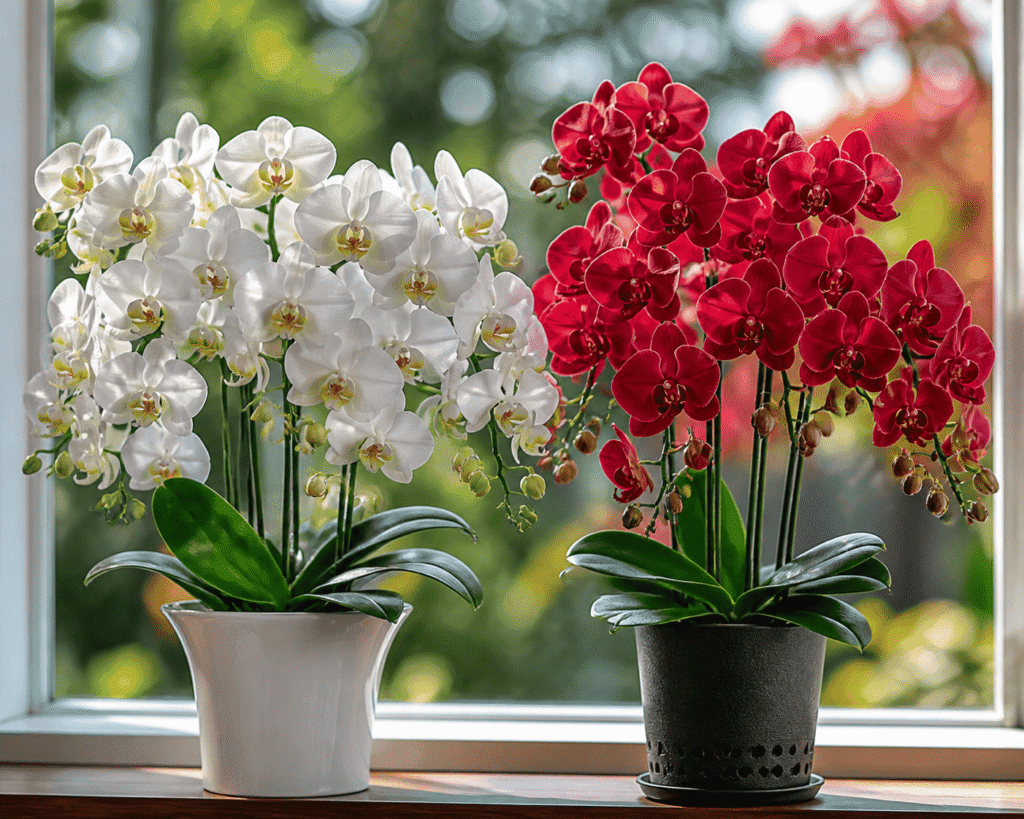
The last flower has fallen. The flower spike is turning brown. One leaf is yellow, and the roots inside the pot do not look as fresh as they once did.
Is your Phalaenopsis orchid dead—or merely between flowering seasons?
Every year, many living moth orchids are discarded because their owners understandably mistake the end of flowering for the end of the plant. Others are thrown away because their leaves are wrinkled, their roots look untidy or they appear slow to recover.
Phalaenopsis orchids can look badly damaged and still retain enough healthy tissue to grow again. A firm root, a living crown or a tiny green growing tip may be all the evidence you need to justify giving the plant another chance.
Recovery is never guaranteed. A severely weakened orchid may require months to produce new roots and leaves, and some plants are too badly damaged to save. But before you place yours in the trash, check these five signs.
Quick Answer: Is My Orchid Still Alive?
Your Phalaenopsis may be worth saving if it has one or more of the following:
- At least one firm, living root
- A firm crown or section of living stem
- At least one firm leaf with healthy green tissue
- A new root tip, leaf, flower spike or small plantlet
- Damage that has stopped spreading and can be managed
The absence of flowers is not evidence that the orchid is dead. Neither is a dry flower spike, one yellow bottom leaf or several aerial roots growing outside the pot.
Judge the plant by its roots, crown, leaves and active growth—not by its flowers alone.
First: Flowering Has Ended, but the Plant Has Not
Phalaenopsis orchids have different stages of growth.
A plant flowers, rests from flowering and then directs energy toward roots and leaves. When it has rebuilt sufficient strength and receives suitable environmental signals, it may produce another flower spike.
The flowers are temporary. The orchid itself is a long-term plant.
After the last flower drops, the spike may remain green or turn yellow and brown. A brown spike is dead flower-supporting tissue, but it does not mean the entire plant has died.
If the leaves, roots and crown remain healthy, your orchid is still very much alive.
Sign 1: At Least One Root Is Firm and Alive
The roots should be the first place you inspect.
Phalaenopsis roots do more than hold the plant in its pot. They absorb water and minerals, exchange gases with the surrounding air and store some of the plant’s resources.
A struggling orchid may have lost many roots but still possess a few that can support recovery.
What a living root looks and feels like
A healthy or viable root is generally:
- Firm rather than mushy
- Rounded rather than completely flat
- Green when wet or silvery when dry
- White, cream or yellowish if it grew away from light
- Capable of producing a bright green or reddish growing tip
Do not judge a root by color alone. Roots inside an opaque area of the pot may be yellow or cream because light did not reach them. They can still be healthy if they feel firm.
What a dead root looks and feels like
A dead root may be:
- Soft or mushy
- Hollow
- Flat and papery
- Black or very dark brown
- Covered by an outer layer that slips away easily
- Brittle and completely dry
A mixture of healthy and dead roots is common in a neglected orchid.
Why one living root matters
One firm root does not guarantee recovery, but it means the plant still has a way to take up at least some water.
An orchid with very few roots must be managed carefully. A large pot filled with wet medium will not help it. The limited root system cannot use that much water, and prolonged wetness can damage the remaining roots.
What to do
Remove the inner pot and gently examine the roots.
If the medium has broken down, carefully remove it. Trim only roots that are clearly dead, using a clean cutting tool. Preserve every firm root you can.
Repot the orchid in a small, well-drained pot suited to the remaining root system. Use fresh orchid medium rather than ordinary potting soil.
The goal is to provide moisture, oxygen and stability—not to keep the roots constantly wet.
Sign 2: The Crown or Stem Is Still Firm
The crown is the central growing point from which new Phalaenopsis leaves emerge.
A firm crown is an important sign of life. Even if the plant has lost roots or leaves, living stem tissue may retain the ability to support recovery.
Signs of a viable crown or stem
Look for:
- Firm tissue at the center of the plant
- A center leaf that remains securely attached
- No rapidly spreading dark area
- No unpleasant smell
- Firm leaf bases
- A visible green section of living stem
Warning signs
Be more concerned when:
- The center leaf pulls out easily
- The crown is black, brown or soft
- Several leaves are loose at their bases
- Dark damage is spreading down the stem
- The tissue is wet or foul-smelling
Damage to the crown is serious because a Phalaenopsis normally produces new leaves from this single central growing point.
However, crown damage does not always mean immediate death. If living lower stem tissue and healthy roots remain, the plant may occasionally produce a small plantlet, called a basal keiki, from its base.
That outcome is possible, not guaranteed. It may also take considerable time.
What to do
Keep the crown dry and provide gentle air movement.
Do not pour water into the center of the plant. If water enters the crown during watering, tilt the orchid to drain it or absorb the water carefully with the corner of a clean paper towel.
If the crown contains soft or spreading damage, separate the orchid from your other plants and seek a reliable diagnosis. Avoid applying several home remedies at once because they can damage healthy tissue and make the problem harder to assess.
Sign 3: At Least One Leaf Still Has Firm Green Tissue
Leaves manufacture and store resources that help an orchid survive and rebuild.
A leaf does not have to look perfect to remain useful. A scratched, partly yellow or wrinkled leaf may still contribute to the plant as long as it contains living green tissue and is not affected by actively spreading damage.
A useful leaf may be:
- Firm or partly firm
- Mostly green
- Securely attached
- Free from soft, spreading lesions
- Wrinkled but still alive
- Damaged in one stable, dry area
Do not remove leaves simply because they look unattractive
A recovering orchid needs every functioning part it can keep.
Removing a damaged but stable leaf reduces the plant’s remaining green area and creates a new wound. If part of the leaf is still green and the damage is not spreading, leaving it attached is often the better choice.
What about a yellow bottom leaf?
One lowest leaf that slowly turns yellow is usually undergoing normal aging. The orchid is withdrawing resources from it before allowing it to fall.
Let the leaf detach naturally. Do not pull it off while it remains firmly connected to the plant.
What about wrinkled leaves?
Wrinkling means the leaf has not received enough water internally, but it does not tell you why.
Possible reasons include:
- The pot stayed dry for too long.
- Most roots died from prolonged wetness.
- The roots were damaged during repotting.
- The remaining roots are too few to support the leaves.
- The plant experienced unusually hot or dry conditions.
Before giving more water, inspect the roots.
An orchid with dry medium and healthy roots may need thorough watering. An orchid sitting in wet medium with dead roots needs root-zone correction—not more water.
Older wrinkled leaves may never become completely smooth again. Judge recovery by new roots and leaves instead.
Sign 4: You Can See New Growth
New growth is one of the clearest signs that an orchid is actively trying to recover.
Look closely for:
- A bright green root tip
- A small new root emerging from the stem
- A new leaf beginning in the crown
- A developing flower spike
- A small basal plantlet
- An older root beginning a new side branch
A root tip is usually rounded and smooth. Its color may be bright green, yellow-green or reddish, depending on the plant.
A flower spike is generally flatter and more pointed than a root. It often has small scale-like coverings or nodes along its developing length.
Why new roots matter most during recovery
A flower spike is exciting, but roots should normally be the main priority for a weak plant.
Flowers use stored resources. A severely weakened orchid may not be ready to support them. Strong roots and leaves provide the foundation for future flowering.
If a badly stressed plant begins producing a spike while having very few roots, some growers choose to remove the spike so the plant can direct more resources toward recovery. This is a judgement call based on the plant’s condition.
What to do
Once you see new root tips:
- Avoid damaging them during repotting.
- Keep the plant stable so new roots are not rubbed or broken.
- Maintain an appropriate watering cycle.
- Provide bright, indirect light.
- Fertilize modestly only when roots can support active growth.
Do not repeatedly move the plant to look for progress. Photograph it weekly instead.
Sign 5: The Damage Has Stopped Spreading
An orchid does not need to be flawless to recover. It needs to have a problem that is stable or manageable.
A dry sunburn patch, an old scar or a broken leaf may remain visible for the life of that leaf. These areas do not necessarily threaten the plant if they stop expanding.
The most important question is:
Is the damage stable, or is it still spreading?
Signs that damage may be stable
- The affected area remains the same size.
- Its edge is dry rather than soft.
- No new leaves become affected.
- Roots are beginning to grow.
- The crown remains firm.
- The plant has no unpleasant smell.
- A pest has been identified and brought under control.
Signs that the problem may still be active
- A spot enlarges from day to day.
- Tissue becomes soft or water-soaked.
- Yellowing spreads rapidly.
- Several leaves develop similar symptoms.
- The stem or crown becomes darker.
- Leaves loosen at their bases.
- New pest activity continues to appear.
- More roots become soft despite corrective care.
How to monitor the problem
Take a clear photograph with the date. For a leaf spot, you can place a small mark near—but not through—the edge of the affected area.
Check it again after 24 to 48 hours.
If the problem remains stable, the orchid may be able to grow beyond the damage. If it continues expanding, isolate the plant and seek help with identification.
Five Signs at a Glance
| Sign | Encouraging evidence | Concerning evidence |
| Roots | At least one firm root or active green tip | Every root is soft, hollow or dead |
| Crown or stem | Firm tissue and secure leaf bases | Soft, dark or spreading damage |
| Leaves | At least one firm area of green tissue | All leaves are loose, soft or rapidly declining |
| New growth | Root tip, leaf or basal plantlet | No activity over a long period under suitable conditions |
| Stability | Damage is dry and no longer expanding | Damage continues spreading rapidly |
An orchid does not need all five encouraging signs to be alive. However, the more healthy structures it retains, the better its prospects.
A Ten-Minute Save-or-Discard Inspection
Step 1: Isolate the orchid
Move it away from healthy plants until you know whether pests or infectious disease are involved.
Step 2: Remove the decorative outer pot
Look for standing water. A Phalaenopsis should not remain in a pool of water inside its container.
Step 3: Examine the roots
Inspect them through the clear pot. If necessary, remove the plant carefully and feel the roots.
Count the firm roots rather than focusing only on the dead ones.
Step 4: Inspect the crown and stem
Check the central growing point and the places where leaves join the stem.
Step 5: Examine every leaf
Look at both surfaces and inspect the leaf joints for pests.
Step 6: Search for active growth
Look for root tips, a new leaf or a basal plantlet.
Step 7: Photograph the plant
Record the starting condition so you can judge whether it improves.
What Commonly Looks Like Death—but Is Not
The flowers have fallen
Flower loss is normal. Flowers are temporary structures.
The flower spike has turned brown
A dry spike can be removed near its base. Its death does not mean the plant is dead.
One bottom leaf is yellow
This is often natural aging when the rest of the orchid is healthy.
Aerial roots are growing outside the pot
Aerial roots are normal Phalaenopsis growth. Do not cut them merely because they look untidy.
The leaves are wrinkled
Wrinkling indicates a water-supply problem, but the orchid may recover if it retains living tissue and can produce new roots.
The plant has no flowers for months
A healthy Phalaenopsis normally spends time growing leaves and roots between flowering periods.
Some roots are yellow
Roots that grew without light may be cream or yellow and still be healthy. Test their firmness.
A leaf has a dry brown patch
Old sun or physical damage may remain permanently visible without spreading.
When Recovery Is Less Likely
Sometimes discarding a plant is reasonable, especially when it threatens the rest of a valuable collection.
Recovery is less likely when:
- All roots are dead.
- All leaves have detached.
- No firm crown or stem tissue remains.
- Decay has spread through the entire plant.
- The whole plant has dried completely.
- A serious problem continues spreading despite appropriate action.
- A confirmed virus or difficult disease threatens other orchids.
- The plant requires more time and isolation space than the grower can provide.
“Still technically alive” and “practical to save” are not always the same thing.
A grower with one treasured orchid may choose to attempt a long recovery. Someone with a large collection may decide that protecting healthy plants is more important than saving one questionable specimen.
Either decision can be reasonable.
If you discard a plant because pests or disease may be involved, do not place it in home compost intended for other plants. Seal it appropriately, clean the growing area and disinfect reusable tools and containers before using them again.
A Simple Recovery Plan
If your inspection reveals a reasonable chance of recovery, begin with the basics.
1. Remove the failed medium
Old, compacted or decomposed material can stay wet too long and restrict airflow.
2. Preserve every viable root
Trim only roots that are clearly dead. Healthy roots are valuable, even if they are stained or oddly shaped.
3. Match the pot to the root system
A small root system does not need a large pot. Too much wet medium around too few roots can slow drying and encourage further damage.
4. Stabilize the plant
Movement can damage new root tips. Stake or position the orchid so it does not wobble.
5. Provide bright, indirect light
A recovering orchid needs light to produce energy, but harsh direct sunlight can add further stress.
6. Water according to the roots and medium
Do not follow a rigid calendar. Check moisture before watering and allow excess water to drain.
7. Keep water out of the crown
Water the root zone. Remove any water that collects between the leaves.
8. Provide gentle air movement
Fresh, gently moving air helps wet surfaces dry. Avoid strong drafts.
9. Fertilize modestly
Do not try to force recovery with heavy fertilizer. Wait until the plant has functioning roots and active growth, then feed lightly according to product directions.
10. Be patient
Recovery may be measured in months, not days.
A new root tip is progress. A small new leaf is progress. Stability without further decline is also progress.
What Not to Do
Do not water more simply because the leaves are wrinkled
Inspect the roots first. Damaged roots can make a wet orchid look dehydrated.
Do not place the plant in a sealed, constantly wet environment
High humidity without airflow can encourage further problems.
Do not use ordinary potting soil
Phalaenopsis roots require an airy orchid medium.
Do not remove every unattractive part
Stable leaves and roots may still be contributing to recovery.
Do not apply several home remedies
Cinnamon, peroxide and other commonly recommended materials are not universal cures. Using multiple treatments can injure living tissue or confuse the diagnosis.
Do not expect flowers immediately
Recovery should begin with functioning roots and leaves.
Do not keep buying products instead of correcting conditions
No tonic can replace suitable light, drainage, airflow and watering.
Do not return a possibly infested plant to the collection too soon
Keep it separate until you are confident that the problem is controlled.
How Long Should You Give the Orchid?
There is no universal recovery deadline.
Growth rate depends on:
- The number of viable roots
- The condition of the crown and stem
- Available stored resources
- Light
- Temperature
- Season
- The original cause of decline
- Whether the cause has been corrected
Photograph the orchid every two weeks and look for trends.
Ask:
- Is the decline continuing?
- Are roots remaining firm?
- Has a root tip appeared?
- Is the crown stable?
- Is a new leaf developing?
- Has the plant stopped losing tissue?
Do not dig up or repot the orchid repeatedly to check for progress. Constant disturbance can damage the very roots you are trying to encourage.
Frequently Asked Questions
Is an orchid dead when all the flowers fall?
No. Flower loss is a normal part of the flowering cycle. Inspect the roots, leaves and crown to judge the plant’s health.
Is a brown flower spike a sign that the orchid is dead?
No. The spike may die after flowering while the main plant remains healthy. A completely dry spike can be cut near its base with a clean tool.
Can a Phalaenopsis survive with no roots?
Occasionally, a plant with a firm crown, useful leaves and living stem tissue may produce new roots. Recovery is difficult and not guaranteed.
Can an orchid survive with only one leaf?
Possibly, if it retains living roots and a viable crown or stem. Its recovery capacity will depend on the condition of its remaining tissue.
Can an orchid survive after crown damage?
Sometimes. If healthy roots and living lower stem tissue remain, it may produce a basal plantlet. This can take a long time and is not assured.
Should I cut off all brown roots?
Remove only roots that are clearly dead, hollow or soft. Brown staining alone does not prove that a root is dead.
Should I repot a sick orchid immediately?
Repot if the medium has failed, drainage is poor or dead roots must be removed. If the medium and roots are sound, unnecessary repotting may add stress.
Should I fertilize a rootless orchid?
Heavy fertilizer will not replace missing roots. Concentrate first on suitable moisture, airflow, light and the development of new roots.
How will I know that the orchid is recovering?
The best evidence is a new root tip, new leaf or basal plantlet. Stabilization—no further decline—is also an encouraging early sign.
When should I stop trying?
Consider stopping when no viable root, leaf, crown or stem tissue remains; when decay continues spreading; or when keeping the plant threatens healthier orchids.
Give the Plant a Fair Inspection
A faded Phalaenopsis may look disappointing after months of beautiful flowers. A struggling orchid can look even worse after losing roots or leaves.
But appearance alone does not determine whether it is alive.
Before discarding the plant, check:
- Are any roots firm?
- Is any crown or stem tissue still alive?
- Does at least one leaf contain useful green tissue?
- Can you see any new growth?
- Has the damage stopped spreading?
If the answer to one or more of these questions is yes, the orchid may deserve another chance.
Saving it will require realistic expectations. The next reward may not be a flower. It may be one small green root tip—and that root tip can be the beginning of recovery.
Join the Orchid Bloom Lab email list to receive practical, science-based orchid care guidance and downloadable diagnostic resources. You will learn what to inspect, what the signs may mean and what to do next—without relying on guesswork.
Join the email list at https://orchidbloomlab.com
You can also subscribe to the Orchid Bloom Lab YouTube channel for clear visual guidance on watering, root health, repotting, lighting, flowering and rescuing troubled orchids.
Subscribe at https://www.youtube.com/@OrchidBloomLab
Orchid Bloom Lab™
Science-Based Orchid Flowering Tips—Grow Better. Bloom More.